

I’ve been an avid reader my whole life. The kind of person who disappears into a book for an entire Sunday and resurfaces confused about what year it is. Reading has always been my favorite escape, the one thing I could count on to quiet my brain down.
A few months ago, I realized I couldn’t do it anymore.
I’d sit down with a book I genuinely wanted to read, get through a few pages, and feel this itch to pick up my iPad. Not because anything urgent was happening. Just… an itch. I’d put the book down “for a second” and resurface twenty minutes later having watched a dozen videos I couldn’t even remember. I tried to tell myself I was just busy, or tired, or in a slump. But this wasn’t a slump. This was something different, and it scared me enough to go looking for an actual answer.
If you’re around my age, you remember the old commercial. An egg. A frying pan. A voice, flat and serious: “This is your brain on drugs.” Then the egg hits the pan, sizzling, and the tagline lands: “Any questions?”
I thought about that PSA a lot while I was digging into this. Because I don’t think we need a metaphor anymore. We have actual brain scans now. And they are asking, and answering, a lot of questions of their own; including, some questions about what happened to me.
The Numbers Are Bigger Than You Think

“Brain rot” isn’t just internet slang anymore. It was Oxford University Press’s Word of the Year for 2024, and now, it’s a term with roughly 200,000 searches a month. (Simply Psychology) When a phrase used to describe cognitive decline from consuming garbage content becomes mainstream enough to top a dictionary’s annual list, that tells you something about how many people are feeling this in their own lives.
A review published in Psychological Bulletin, a journal of the American Psychological Association, examined 71 separate studies with nearly 100,000 total participants. It found that heavy consumption of short-form video was associated with poorer cognition, particularly weaker attention spans and reduced impulse control, along with increased depression, anxiety, stress, and loneliness. (NBC News/Yahoo) This is, by a wide margin, the largest study ever conducted on what short-form video actually does to the human mind.
And then there’s the stat that stops most people cold: a widely cited Microsoft study suggests the average human attention span has dropped to around eight seconds. (Free Malaysia Today) A neuroscientist at the National University of Singapore put the mechanism plainly: “Short-form video trains us to crave quick rewards,” noting that people spend an average of six hours a day on their phones. (Free Malaysia Today)
“The Video Was Getting Through. But No One Was Home.”
If the numbers above feel abstract, this next part won’t.
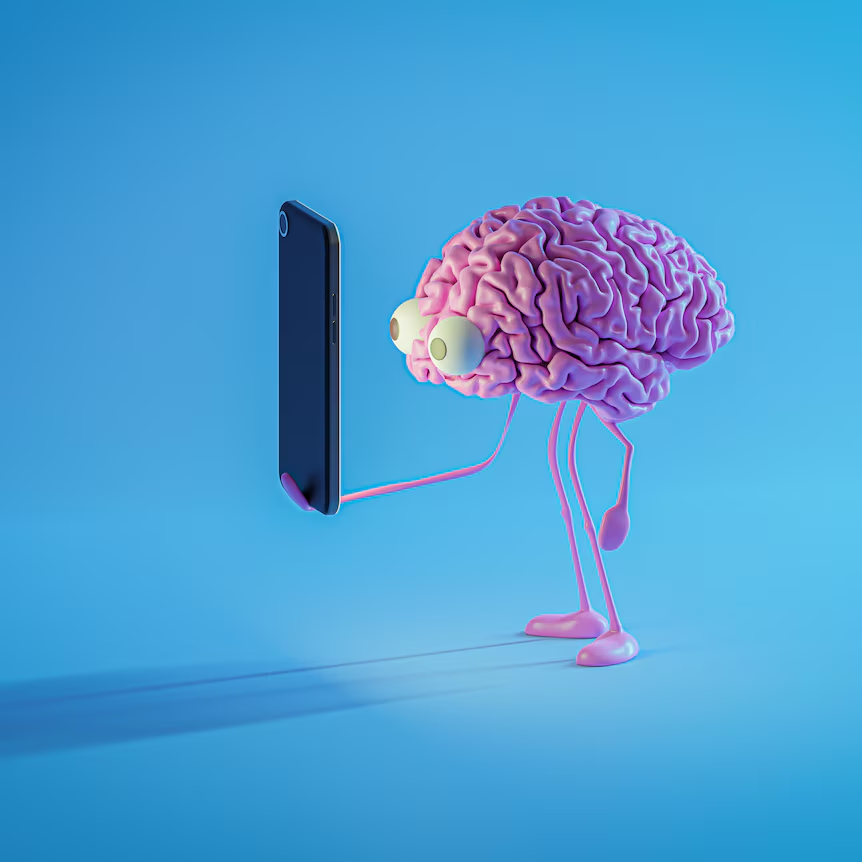
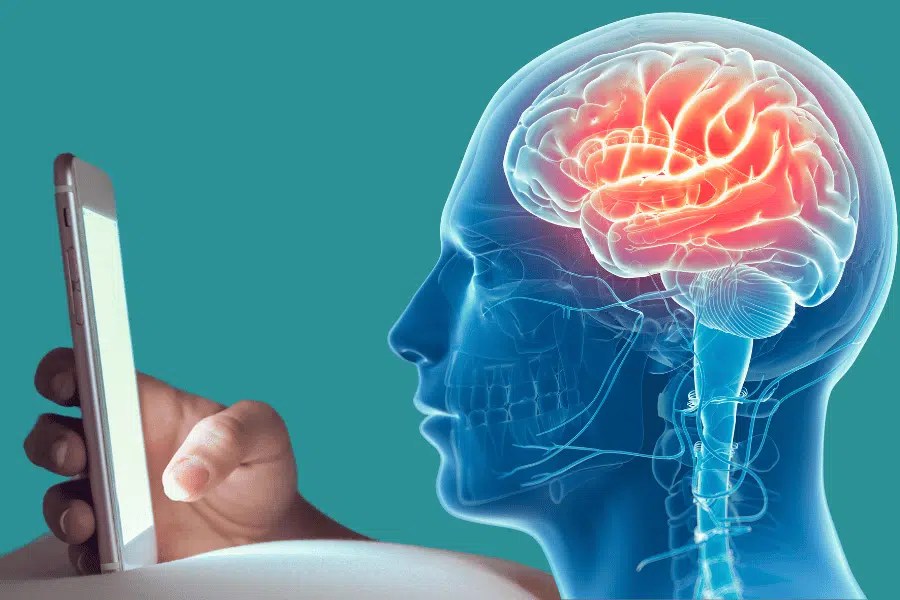
Researchers ran an MRI study looking at what happens in the brain while people watch short-form videos they actually enjoy. The dorsal anterior cingulate cortex, the part of the brain that essentially says “hey, put the phone down,” and the dorsolateral prefrontal cortex, the part that actually makes you do it, didn’t just go quiet during preferred videos. Both regions dropped below their own resting baseline. One writeup summarized it about as chillingly as possible: “The video was getting through. But no one was home.” (RedState)
I want to be fair about this study’s limits, because you deserve the full picture. It came out of a Chinese state institution, which is worth noting. But it was also peer-reviewed, published in a legitimate scientific journal, and pre-registered before data collection began, meaning the researchers couldn’t quietly change their hypothesis after seeing the results. (RedState) And here’s the detail that actually makes it more concerning, not less: the study didn’t even use real TikTok. No algorithm, no personalized “For You” page. Just neutral pre-recorded clips of pets, games, scenery, and people doing things. (RedState) If plain, unoptimized short video can shut down your brain’s self-control centers, imagine what a fine-tuned algorithm engineered specifically to keep you scrolling is doing.
Separate EEG research backs this up. Heavy scrollers, defined as more than two hours of daily use, showed reduced beta-wave variability, a marker of prefrontal impulse control, along with persistent hyper-arousal after use. There was some good news buried in there too: partial recovery in brain activity after 30 days away from the habit. (arXiv)
What Teachers Are Actually Watching Happen

Here’s where this stops being an abstract brain-science conversation and becomes something urgent.
Twelfth-grade reading scores on the National Assessment of Educational Progress, often called the Nation’s Report Card, dropped to their lowest level in more than 20 years. Roughly 64% of eighth graders and 67% of fourth graders are not reading proficiently. That decline has effectively erased 30 years of progress, bringing scores back to levels last seen in the early 1990s. (Brighterly) Peggy Carr, Commissioner of the National Center for Education Statistics, didn’t mince words: “These are some of the largest declines we have observed in a single assessment cycle in 50 years of the NAEP program. Students in 2022 are performing as they did two decades ago.” (Brighterly)
A Texas high school teacher went viral this year after breaking down in tears on camera over his students’ lack of literacy. (AllSides) That’s not a statistic. That’s a person who has dedicated his career to teaching kids to read, watching that basic skill disappear in front of him.
Teachers are also sounding the alarm on classroom management specifically tied to phones. Kimberly Kopko, a senior extension associate at Cornell’s Bronfenbrenner Center for Translational Research, put it plainly: “The research is clear. 72% of high school teachers report that cell phones in classrooms cause a distraction.” (Cornell Human Ecology) Separately, a national survey found 76% of teachers in schools with “bell-to-bell” phone bans reported higher student engagement, and 70% said the environment felt safer. (Wooclap)
I want to be fair here too. Researchers and educators caution that the literacy crisis can’t be pinned on phones alone. Shifts in reading instruction methods and pandemic-era learning loss are real, documented contributors too. (AllSides) But the timeline lines up, and the mechanism makes sense: if a device is measurably degrading attention, impulse control, and the capacity for sustained focus, and children are getting that device younger and younger, it becomes very hard to treat that as coincidence rather than cause.
The Nuance (Because You Deserve It)

I promised you real science, not just alarm, so let’s sit with the pushback for a moment.
A neuropsychologist at Vanderbilt University Medical Center has pointed out that there’s a long history of people crusading against new technology and cultural shifts, and that the long-term picture on short-form video is still genuinely unclear. (NBC News/Yahoo) That’s a fair and important caution. Every generation has had its moral panic, and not all of them aged well.
But here’s a hopeful framing too: “brain rot” is slang, not a clinical diagnosis. The changes researchers are finding appear to be functional rather than structural, meaning they describe habits of attention rather than permanent brain damage, and they seem to be largely reversible with changed behavior. (Simply Psychology) There’s also a genuinely open research question worth sitting with: ADHD diagnoses have risen to about 1 in 9 children as of 2022, and at least one researcher is now asking whether some portion of those diagnoses might actually be capturing the effects of heavy short-form video use rather than ADHD itself. (NBC News/Yahoo)
None of that cancels out what I laid out above. If anything, it makes the core finding more credible, not less, because even the most careful, skeptical version of this research still points in the same direction.
Any Questions?
So here’s where I land, and I’m not going to soften it.
If a fourteen-year-old can sit still for a two-hour movie but can’t make it through ten minutes without reaching for their phone, that’s not a personality quirk. That’s diagnostic. Attention, impulse control, and the ability to sit with a slow, difficult idea long enough to actually understand it, these are not soft skills. They are the basic tools required to function as a literate, capable adult. They are also, not coincidentally, the exact tools an entire generation is being asked to practice less and less, at younger and younger ages.
And yet, I keep coming back to the question I can’t shake: what kind of adults are we raising, if attention span, impulse control, and basic reading comprehension are the casualties of childhoods spent scrolling? What happens when those kids are the ones sitting on juries, running households, voting on the issues that will shape the next fifty years, if they’ve never built the capacity to sit with something difficult long enough to actually understand it?
So, if I’m being honest, this isn’t just about kids anymore. I’m a grown woman who has loved reading her entire life, and I found myself unable to finish a chapter in a trashy romance novel without reaching for one of my devices. If it can happen to someone who has spent five decades building a relationship with books, I don’t think any of us are as immune to this as we’d like to believe.
I don’t think this is inevitable, and I don’t think it’s too late. The research suggests real, meaningful recovery is possible with less use and more friction between us and our devices, kids and adults alike. But that requires actually treating this as the emergency the data says it is, instead of something we quietly accept because the device is convenient and, for the moment, everyone’s quiet.
Where do you land on this? Have you noticed changes in your own attention span, or in your kids’ or grandkids’? Have you made any changes in your own house because of it? I want to hear what’s actually happening in your world, not just what the studies say.
💙👇